
PCI Compliance For Invoice Payments And Payment Links
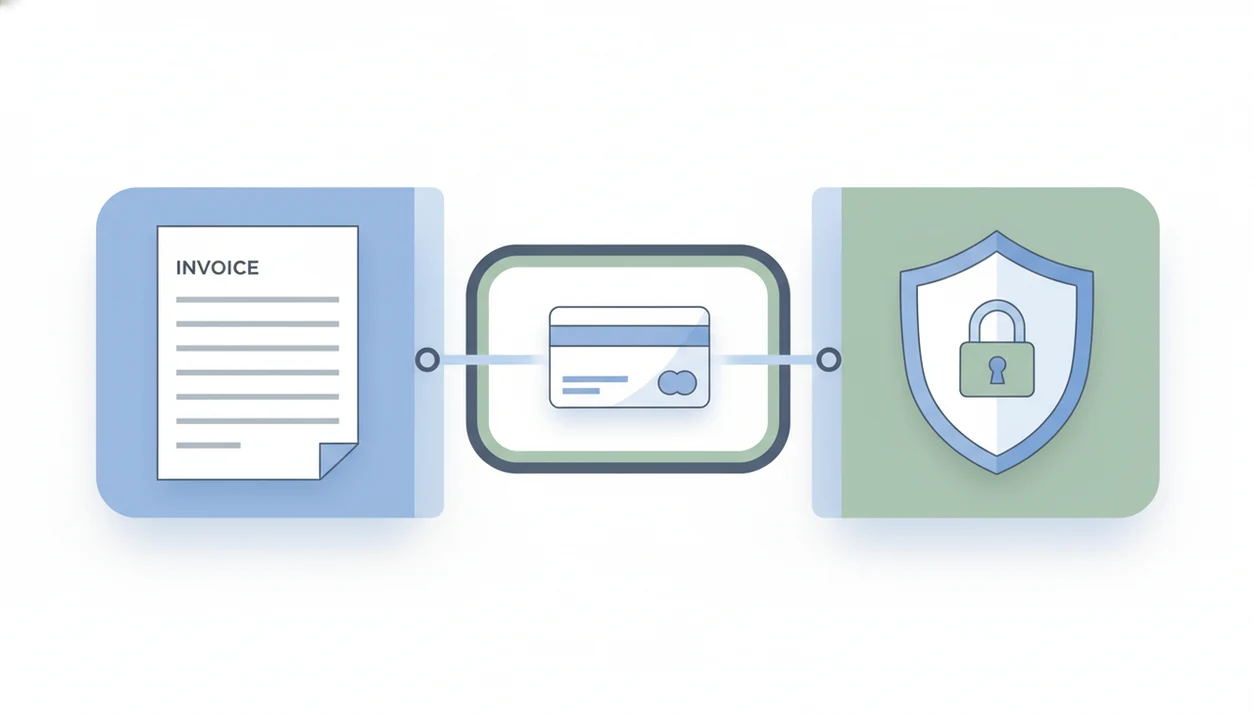
PCI compliance for invoice payments depends on whether your invoice workflow stores, processes, transmits, or can access cardholder data. For most freelancers and small businesses, the safest path is to send invoice payment links that route card details directly to a PCI-compliant processor instead of collecting card numbers yourself.
This guide is general payment-security information, not a PCI certification, legal opinion, or substitute for guidance from your acquiring bank, payment processor, or a qualified PCI professional.
> Definition: PCI DSS is the Payment Card Industry Data Security Standard, a card-brand security standard for any organization that stores, processes, or transmits payment card account data.
TL;DR
- Invoice payment security starts with keeping card numbers out of emails, PDFs, spreadsheets, notes, and your own devices.
- PCI DSS invoice links reduce your scope when customers enter card details on a compliant processor-hosted payment page.
- Using a compliant processor helps, but merchants still have duties such as secure configuration, access control, and annual validation.
PCI compliance for invoice payments at a glance
PCI compliance for invoice payments means your card-payment workflow must follow PCI DSS whenever cardholder data is stored, processed, transmitted, or reachable by your systems. The invoice itself may be simple, but the payment path behind it matters.
PCI is not a government law. It is an industry standard enforced through card brands, acquiring banks, merchant agreements, and payment processors. If a customer pays by card from a PDF invoice, email invoice, or payment link, the question is where the card number goes.
A clean setup keeps the invoice record separate from card entry. The customer clicks a payment link, enters card details on a hosted processor page, and the invoice app records payment status after approval.
Common processor-hosted payment examples include Stripe Checkout, Square payment links, and PayPal Checkout; the important test is whether the provider-hosted page, not the invoice record, collects the card details.
Tools like Invoice Maker Teo help create, send, track, and manage invoices, while card payment handling should route through compliant payment providers where applicable. A good invoice maker app for freelancers and small businesses helps create, send, and track invoices and estimates, not replace a payment processor, acquiring bank, or PCI assessor.
Five PCI DSS invoice links facts small businesses should know
- PCI DSS applies to any business that accepts, transmits, or stores cardholder data. Business size does not remove the duty.
- Payment links reduce PCI scope only when card entry happens on the processor side. A link that opens a hosted checkout is different from typing card numbers into your own form.
- Small merchants usually still need the correct SAQ. The PCI Security Standards Council describes PCI DSS as a baseline of technical and operational requirements for payment account data, not an optional checklist source.
- Processors and invoice platforms can be service providers. They may have separate validation duties, contracts, and security controls.
- Outsourcing reduces PCI burden but does not eliminate merchant responsibility. You still manage logins, permissions, settings, and how staff handle customer messages.
The invoice number still matters. So does the payment link.
For small service businesses, hosted invoice payment links are often easier than manual card collection because they keep raw card numbers out of ordinary invoice records.
How PCI compliance for invoice payments works behind the scenes
PCI compliance for invoice payments works by tracing where cardholder data travels and which systems can affect that path. PCI “scope” includes systems that store, process, or transmit payment account data, plus connected systems that could impact that cardholder data environment.
In a lower-scope invoice workflow, the customer opens a PCI DSS invoice link, lands on a hosted checkout page, enters card details, and the gateway sends the transaction to the processor, acquiring bank, and card network. The invoice app may receive a status update or token, not the raw card number.
Other methods change the scope. A redirect to a hosted page is usually cleaner. Embedded payment fields can still reduce exposure if the processor controls the sensitive fields. Direct API card capture, virtual terminals, and manual phone collection usually require tighter controls.
Tokenization replaces stored card numbers with processor references. In plain English, your records show “card on file,” not the card itself. That is the point.
Invoice payment security boundaries by card-handling method
Invoice payment security depends heavily on how the card is collected. The safer boundary is simple: keep card numbers out of your invoice PDF, email thread, spreadsheet, memo field, and phone notes.
| Card-handling method | Typical PCI scope | Practical boundary |
|---|---|---|
| Emailed invoice with no card acceptance | Lower | Invoice is a bill only; no card data is collected. |
| Hosted payment link | Lower | Customer enters card details on processor-hosted checkout. |
| Embedded checkout | Medium | Scope depends on whether sensitive fields are controlled by the processor. |
| Virtual terminal | Medium to higher | Merchant keys card data into a web terminal, often requiring SAQ C-VT. |
| Phone card entry | Higher | Staff hear or write down card details, which creates handling risk. |
| Stored cards | Higher | Use tokens or processor vaults, not raw card storage. |
Do not paste card numbers into invoice notes because a client says, “Just keep it on file.” That shortcut follows the PDF copy, the client record, and sometimes the backup export.
The exact SAQ depends on the processor, integration, acquiring bank, and payment flow. For adjacent security basics, our secure invoice maker app guide covers account and document handling.
Specific PCI DSS guarantees in a secure invoice payment setup
A secure invoice payment setup is designed to reduce card-data exposure, not make breaches impossible. Strong controls create clear boundaries between invoices, client records, and card payment systems.
- Hosted card entry. Card details should be entered into a compliant payment environment, not stored in the invoice app’s ordinary business records.
- Encrypted transmission. Payment pages should use encryption and secure transmission so card data is not exposed in transit.
- Restricted access. Access to payment settings, invoices, and customer records should be limited to authorized users.
- Tokenized saved methods. Tokens or processor references should replace raw card numbers when saved payment methods are offered.
- Auditable settings. Payment configuration should be reviewed, especially after staff changes or a new integration.
The paid stamp after lunch is useful. The card number is not.
Security controls materially reduce risk when card entry, storage, and processor communication are separated from normal invoice editing.
Common PCI compliance myths about invoice apps and payment links
- Myth: payment links mean PCI does not apply. Safer behavior: use processor-hosted links, then complete the validation path your processor or bank requires.
- Myth: a compliant processor automatically makes the merchant fully compliant. Safer behavior: secure your account, limit users, and keep card numbers out of messages and records.
- Myth: PCI is only for large businesses or ecommerce websites. Safer behavior: assume PCI applies if you accept card payments, even from one freelance invoice.
- Myth: private email, PDFs, and spreadsheets are safe places for card numbers. Safer behavior: treat them as business records, not card-data systems.
A duplicated invoice number in a spreadsheet is annoying. A copied card number in the next column is a security problem.
If you’re asking is online invoicing secure, the answer depends less on the invoice template and more on where sensitive payment data goes.
Merchant duties for PCI DSS invoice links and processors
“What do I still have to do if my invoice payment link uses a PCI-compliant processor?” You still need to choose the right provider, configure the workflow securely, and complete the validation your bank or processor requires.
Use the processor’s hosted payment page or approved integration when possible. Fully outsourced ecommerce-style payment pages commonly point merchants toward SAQ A, while certain web-based virtual terminal setups may require SAQ C-VT; confirm the current form in the PCI SSC SAQ documentation source. Your exact path depends on how card data is handled.
Set strong passwords. Turn on MFA where available. Give payment settings only to people who need them, and train staff not to accept card numbers by email, text, invoice memo, or shared document.
Review processor documentation and acquiring bank requirements annually. A client promise noted after a call should go in the client record. Their card number should not.
For freelancers and small businesses, annual PCI review is usually easier when payment links, user access, and invoice records are kept in separate lanes.
What PCI compliance for invoice payments does not cover
PCI DSS focuses on payment account data. It does not cover every business risk attached to invoices, payment links, clients, tax records, or disputes.
It does not replace fraud prevention, identity verification, chargeback management, tax compliance, bookkeeping controls, or general cybersecurity. It also does not prove that every invoice email is legitimate. In 2023, the FBI’s Internet Crime Complaint Center received 298,878 phishing, vishing, smishing, and pharming complaints, which shows how often attackers use message-based tricks around payments source.
PCI also does not decide whether a customer owes an invoice or whether a payment dispute is valid. That depends on contracts, delivery records, refund terms, and processor rules.
A tax line added after supplies is a billing detail, not a PCI control. For message-specific risks, our email invoice safety guide explains safer sending habits.
When to ask your processor, bank, or a PCI professional
Ask for help before the payment flow changes, not after card numbers have already landed in the wrong place. Your processor, acquiring bank, or a PCI professional can confirm which validation path fits your exact invoice setup.
Use a simple escalation routine when the workflow is unclear:
- Ask your processor which SAQ applies to the exact way customers pay, including hosted links, embedded fields, saved cards, and manually keyed payments.
- Contact your acquiring bank before you store cards, turn on card-on-file features, or replace one payment integration with another.
- Use a PCI professional when virtual terminals, custom payment forms, phone collection, high-risk services, or unusual integrations are part of the process.
- Escalate immediately if card numbers have been typed into emails, invoice notes, exports, spreadsheets, shared drives, chat tools, or customer files.
- Document the decision with the date, payment flow, SAQ guidance, contacts, and settings reviewed, so next year’s PCI check is not rebuilt from memory.
The best time to ask is while the setup is still boring. Once card data spreads through ordinary business records, cleanup is harder.
Limitations
PCI DSS is a baseline, not a guarantee that a breach cannot happen. It lowers known payment-card risks, but it does not remove human error, weak passwords, phishing, or poor setup.
- Scope can be hard to determine. Invoice apps, CRMs, email, mobile devices, websites, and processors may all touch the workflow.
- A compliant processor does not fix insecure merchant behavior. Sharing passwords or storing card numbers in notes can still create exposure.
- Requirements vary. Acquiring bank, processor, region, transaction volume, industry, and payment flow can all change the validation path.
- Virtual terminals need care. Manually keyed payments can bring different SAQ duties than hosted invoice links.
- Professional advice may be needed. Unusual card flows, high-risk industries, and stored-card programs deserve specialist review.
- Small businesses still face admin costs. Even basic SAQs take time, documentation, and annual review.
- Financial impact can be serious. IBM reported the average global data breach cost at 4.45 million USD in 2023 source, and FBI phishing data shows attackers still target payment workflows.
PCI is one part of a safer billing process. Our prevent invoice fraud guide covers fake invoices, impersonation, and payment redirection risks outside PCI.
FAQ
Does PCI apply to invoices?
Yes. PCI applies when invoice payments involve cardholder data, even if the invoice itself is emailed, sent as a PDF, or created in an app.
Are payment links PCI compliant?
Payment links can support PCI-compliant workflows when card entry happens through a compliant hosted processor page. The merchant still needs the right setup and validation.
Do freelancers need PCI compliance?
Freelancers who accept card payments are subject to PCI duties regardless of business size. Using tools such as Invoice Maker Teo does not remove processor or merchant requirements.
What is SAQ A?
SAQ A is a common self-assessment path for merchants whose card data functions are fully outsourced to validated third parties. It often fits hosted payment page workflows.
What is SAQ C-VT?
SAQ C-VT is for certain merchants who manually key card payments into a web-based virtual terminal. It can apply when staff enter card details themselves.
Can I email card numbers?
No. Emailing card numbers is unsafe and generally increases PCI risk because the data can remain in inboxes, backups, forwards, and search results.
Who enforces PCI compliance?
PCI is enforced by card brands, acquiring banks, and payment processors through merchant agreements. It is not enforced like a government statute.
Does PCI stop invoice fraud?
No. PCI helps protect payment card data, but it does not by itself stop phishing, fake invoices, business email compromise, chargebacks, or payment redirection scams.